
Politics
We will start work on Padma, Teesta barrages soon: PM
Translated by Burhan Joy
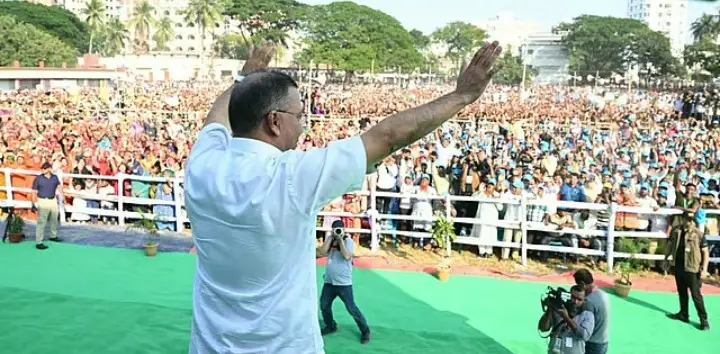
Prime Minister and BNP Chairman Tarique Rahman has pledged to begin and complete work quickly on barrages across the Padma and Teesta rivers, saying the government will take the necessary steps to secure the country’s fair share of water.
The two projects will play an important role in increasing agricultural production, expanding irrigation and addressing water shortages, he said.
He also outlined plans to excavate 20,000 kilometres of canals over the next five years, provide farmer cards to 40 lakh farmers, double the number of beds at upazila health complexes and reopen closed factories.
The prime minister made the remarks as chief guest at an incentive distribution ceremony for sugarcane growers and a public rally at Rajshahi’s historic Madrasa Maidan on Tuesday afternoon, October 20.
“The Padma and Teesta are two major rivers of the country. The government has decided to build barrages across these rivers. Through this, we will try to tackle water shortages and increase agricultural production,” Tarique said.
Pointing to declining flows in the Padma, he said people in the Rajshahi region had long felt the shortage. Ensuring water supplies was essential to improving agriculture and people’s lives in the region, he added. The government would discuss the country’s fair share of water with the relevant parties and, if necessary, go as far as needed to secure that right.
The Padma barrage would benefit people in about 14 districts, including Rajshahi and surrounding areas, the prime minister said.
Describing agriculture as the foundation of the economy, he said: “If farmers survive, agriculture will survive; if agriculture survives, the country will survive.”
That belief had prompted the incentives for sugarcane growers, Tarique said. An initiative had been taken to deliver the assistance to about 39,000 growers to ease some of the cost of cultivation next season.
Referring to the BNP’s pre-election pledge to stand by farmers, he said: “Within seven days of forming the government, we fulfilled our promise to waive agricultural loans of up to Tk 1 lakh, including interest. About 13 lakh farmers across the country have benefited.”
Work is under way to compile lists of landless, marginal, small, medium and large farmers. Farmer cards will be distributed in phases once that process is complete, he said.
“Through the farmer cards, farmers will receive assistance with the fertiliser, seeds and pesticides needed for their crops. Even if they grow two or three crops a year, the government will try to ease their hardship by providing inputs for at least one crop. The cards will also provide access to crop insurance and bank loans,” Tarique added.
Stressing the importance of giving farmers access to information technology, he said the cards would allow them to receive weather information on their mobile phones. Knowing whether it would rain the next day would help them decide in advance when to sow seeds or apply fertiliser. The government plans to offer about 10 types of benefits through the cards.
The prime minister also outlined canal excavation and river restoration programmes to address agricultural water shortages.
“The canal excavation programme began during the time of martyred president Ziaur Rahman. Initiatives were also taken then to develop the Barind region. Continuing that work, the government has resumed excavating canals and rivers to expand irrigation for farmers and ease water shortages for rural people,” he said.
Tarique said the government had set a target of excavating 20,000 kilometres of canals over the next five years and claimed that work on about 800 kilometres had been completed in the past eight months.
He expressed hope that the programme would provide irrigation water, ease shortages in Rajshahi and other northern areas where groundwater levels had fallen, and help replenish groundwater.
Outlining plans to bring healthcare to people’s doorsteps, the prime minister said: “Over the next five years, the number of beds at every upazila health complex in the country will be increased from 50 to 100. Villagers will then no longer have to travel to distant district towns or major cities for treatment of common illnesses. While seriously ill patients may need to go to larger hospitals, the government aims to ensure primary care and treatment for common illnesses at the upazila level.”
He said upazila hospitals would have separate beds for women and children, as well as planned dialysis facilities for kidney patients. The government wants to bring healthcare closer to ordinary people through these initiatives.
Referring to local leaders’ demands concerning healthcare in Rajshahi, Tarique said: “There has been a demand to increase the number of beds at a medical facility here from 1,300 to 2,500.” He responded positively to the proposal.
On efforts to reduce treatment costs, the prime minister said: “Taxes have been reduced on medicines used in dialysis for kidney patients.”
According to him, dialysis previously cost about Tk 1,200–1,500, but the cost has now fallen to about Tk 700–800.
He said taxes had also been reduced on some equipment used to treat heart disease. As a result, he claimed, some medical supplies that previously cost about Tk 1 lakh 20 thousand to Tk 1 lakh 30 thousand now cost Tk 60,000–65,000.
Stressing the importance of reopening factories to create jobs, Tarique said: “Many workers are unemployed because factories have closed in Rajshahi and elsewhere in the country. The government is discussing reopening these factories with local entrepreneurs. Foreign investors are also being encouraged to invest in Bangladesh. The aim is to increase production and create employment opportunities for workers.”
The prime minister said initiatives had already been taken to reopen six closed factories. There are plans to reopen about 46 more between January and December 2027. He expressed hope that reopening the factories would create jobs and opportunities to export locally manufactured products.
Tarique alleged, however, that some political parties and groups were trying to create unrest to obstruct the government’s programmes.
“The government wants to ensure stability and security in the country. Its goals are to make farmers self-reliant, create jobs for workers, reopen closed industries and reduce unemployment. But some political parties want to slow these initiatives by creating disorder on the streets,” he said.
The prime minister claimed to have received intelligence that fugitive autocratic forces were financing labour unrest at several factories. He alleged that money was being sent from abroad to a group inside the country to foment unrest. He did not, however, provide details of specific individuals, organisations or incidents to support the allegation.
On environmental protection and greening, the prime minister said the BNP had adopted a programme to plant 25 crore trees over the next five years. The trees would provide fruit and shade, protect the environmental balance and help reduce temperatures. He also noted that extensive tree-planting initiatives had previously been undertaken in Rajshahi city under former mayor Mizanur Rahman Minu.
On women’s education and economic empowerment, Tarique said: “During former prime minister Begum Khaleda Zia’s tenure, girls were given the opportunity to study tuition-free up to the intermediate level. The present government has decided to extend free education for girls up to honours level. There are also plans to award scholarships to female students who achieve good results.”
Remembering those killed in the 2024 mass uprising, the prime minister said: “The BNP embraces both the history of the Liberation War and the 2024 mass uprising.”
He referred to the construction of a memorial at Dhaka’s Osmani Udyan to commemorate those killed in the uprising. Initiatives had also been taken to provide employment for members of their families and treatment assistance for injured July fighters, he said.
Tarique alleged that some political parties had not sent representatives despite invitations to an event honouring those killed in the July mass uprising. Political statements should match actions, he said.
Stressing the need to ensure stability, employment and democratic rights, the prime minister said Bangladesh’s people wanted political rights and a peaceful environment alongside economic rights. No one would come from abroad to develop the country; its people would have to build it through their own labour and hard work.
BNP Acting Secretary General Advocate Ruhul Kabir Rizvi chaired the rally. Other speakers included Land Minister Mizanur Rahman, Cultural Affairs Minister Nitai Roy Chowdhury, BNP Standing Committee Member Gayeshwar Chandra Roy, BNP chairperson’s adviser Major General (retd) Sharif Uddin, Dhaka district BNP President Nipun Roy Chowdhury, Rajshahi-5 (Puthia-Durgapur) MP Professor Nazrul Islam Mondal, Rajshahi-6 (Bagha-Charghat) MP Abu Sayeed Chand, Rajshahi-3 MP Advocate Shafiqul Haque Milon and MP Abdul Muqtadir.
Earlier, the prime minister landed at Rajshahi’s Hazrat Shah Makhdum Airport on a military aircraft at about 3pm on Tuesday. He travelled directly to the rally at Madrasa Maidan, arriving at 3:20pm. After a brief stay at the Circuit House, he was scheduled to visit the Dharmasabha puja mandap in Rajshahi city on the occasion of Durga Puja.
After completing his Rajshahi engagements, the prime minister was scheduled to leave for Chattogram, visit the puja mandap at JM Sen Hall in Rahmatganj and return to Dhaka at night. During the one-day tour, he is visiting puja mandaps in three divisions and exchanging greetings with members of the Hindu community.