



Science
Jagadish Chandra Bose: From Radio Waves to the Pulse of Plants, The Story of a Scientist’s Endless Quest
Translated by Editor
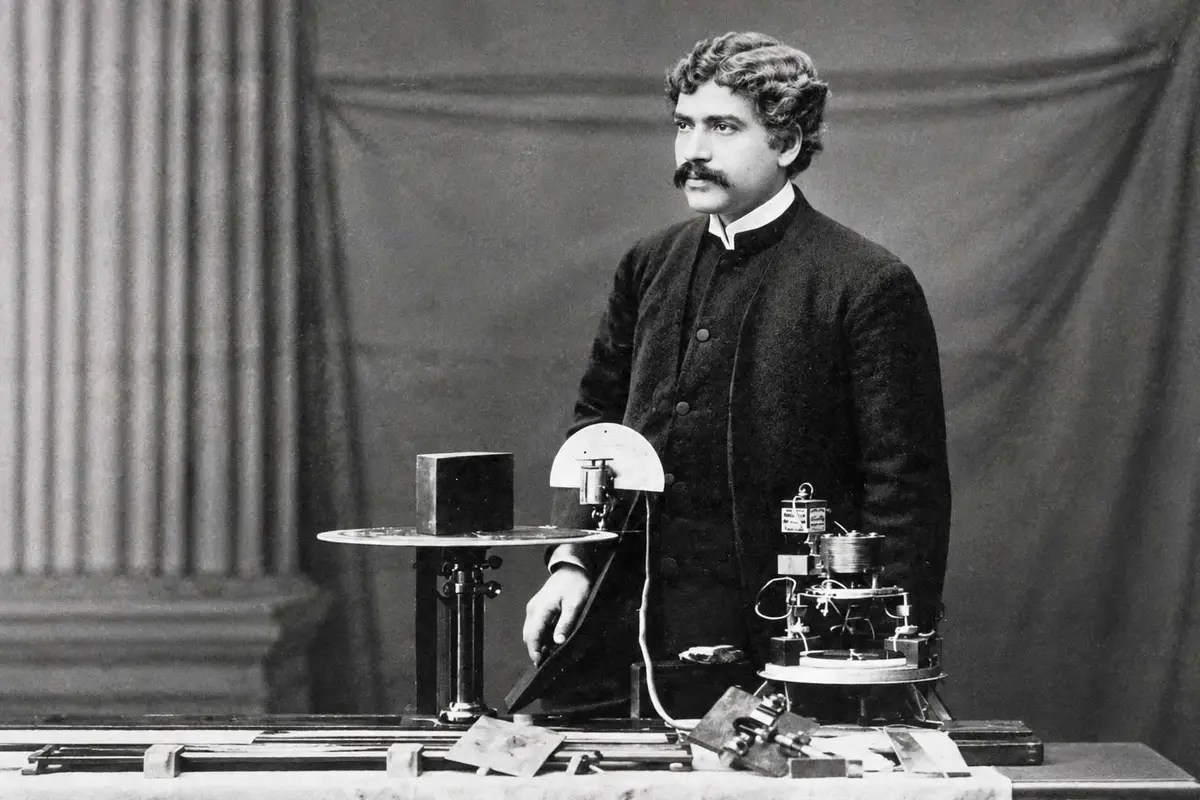
Acharya Jagadish Chandra Bose: An Extraordinary Figure in the Scientific History of Modern South Asia
Acharya Jagadish Chandra Bose was one of the most remarkable figures in the scientific history of modern South Asia. His work in physics, wireless and microwave research, plant physiology, and scientific instrument design made him an experimental scientist who transcended the boundaries of his time. He was born on November 30, 1858, in Mymensingh, then part of the Bengal Presidency and now within the territory of Bangladesh. He died on November 23, 1937, in Giridih, India. Records of the Royal Society also identify his birthplace as Mymensingh, Bangladesh.
However, calling him simply the “inventor of radio” would be an oversimplification, just as treating his research on plants as an isolated chapter would leave his scientific legacy incomplete. One of Bose’s greatest characteristics was that he did not view different phenomena of nature as separate compartments. The question of whether there was a fundamental connection between the responses of matter, living organisms, and plants continually led him toward new areas of research.
The Foundations of His Childhood and Education
Jagadish Chandra Bose’s father, Bhagawan Chandra Bose, was a government official in British India and a progressive thinker associated with the Brahmo Samaj. It was largely at his father’s insistence that Jagadish Chandra began his early education not at an elite English-medium institution, but at a Bengali-language school. Bose later recalled that children from different social and economic backgrounds studied alongside him at that school. This experience had a profound influence on his intellectual outlook.
He later studied at St. Xavier’s School and College in Calcutta. There, the influence of physics professor Father Eugene Lafont deepened his interest in science. He earned his bachelor’s degree in 1879. He subsequently went to England, where he initially attempted to study medicine but abandoned that path because of illness. He then studied natural sciences at Christ’s College, Cambridge, and in 1884 obtained a BA through the Natural Sciences Tripos at Cambridge. During the same period, he also earned a BSc from the University of London.
This education did more than introduce him to European scientific knowledge. It established a strong foundation in experimentation, observation, and evidence-based inquiry.
Science Against Discrimination at Presidency College
After returning from England, Bose joined Presidency College in Calcutta as a professor of physics. His professional life as an Indian professor in colonial India was far from easy. He faced discriminatory treatment, including lower pay than his British colleagues, as well as inadequate funding and laboratory facilities for research. Nevertheless, he did not abandon his scientific work.
This period was particularly important because it marked the beginning of experiments that would later earn a significant place in the history of wireless communication and microwave science.
His Groundbreaking Research on Microwaves
During the final decade of the nineteenth century, scientists around the world were conducting extensive research on electromagnetic waves. Heinrich Hertz had experimentally demonstrated the existence of electromagnetic waves. Bose extended this knowledge into the region of much shorter wavelengths.
Between 1894 and 1899, his principal research focused on electromagnetic waves with extremely short wavelengths, which would today be considered part of the microwave region. According to historical accounts from the Bose Institute, he generated and experimented with waves as short as approximately 5 millimeters and investigated their reflection, refraction, polarization, and other properties.
In 1895, he conducted a notable demonstration in Calcutta involving the wireless transmission and reception of electromagnetic waves. Historical accounts from the IEEE state that he transmitted and received waves at approximately 60 GHz over a distance of about 23 meters, despite two walls standing between the transmitting and receiving apparatus. The demonstration included the ringing of a bell and the ignition of gunpowder as evidence of signal reception.
An important historical qualification is necessary here. Directly calling Jagadish Chandra Bose the “inventor of radio” oversimplifies the history. The development of wireless communication involved the contributions of Hertz, Lodge, Popov, Marconi, and many other scientists and engineers. Bose’s particular contribution lay in the experimental generation, control, transmission, and detection of extremely short-wavelength electromagnetic waves and the development of associated experimental apparatus. Physics Today has also highlighted his 1895 microwave wireless demonstration as an important event that preceded Marconi’s later demonstrations of wireless telegraphy.
Antennas, Waveguides, and Semiconductor Detectors
Another remarkable aspect of Bose’s research was that he did not limit himself to theoretical work. He frequently designed and constructed highly sophisticated instruments himself according to the requirements of his experiments.
Among the instruments and components used in his research were horn antennas, waveguides, polarizers, dielectric lenses, and various types of detectors. Historical accounts of the Bose Institute identify his waveguides and horn antennas as early precursors to modern microwave engineering.
His research on detectors was also particularly significant. His work with galena-based point-contact detectors has a historical connection to the later development of semiconductor detector technology. In 1904, he obtained a U.S. patent for a detector of electrical disturbances.
Yet this aspect of his career also reveals an important feature of his character. He was generally reluctant to turn his scientific discoveries into commercial products. He strongly preferred to keep scientific knowledge open rather than treat it as private property. Although he eventually obtained a patent, commercialization was never the central purpose of his scientific career.
Why Did He Turn From Wireless Research to Plants?
One of the most fascinating turning points in Bose’s life was his shift in research.
During the first stage of his career, he was deeply involved in experimental physics. Gradually, however, his interest moved toward a more fundamental question:
Is there a fundamental similarity between the responses of living and non-living matter?
While experimenting with metals, electrical detectors, and living tissues, he observed measurable similarities in their responses to different stimuli. During the research period from 1899 to 1902, this question gradually led him from physics toward biophysics and plant physiology.
After approximately 1901, the physiological responses of plants became the central focus of his research.
Do Plants Respond to Stimuli?
Today we know that plants display complex responses to light, temperature, touch, chemicals, electrical signals, and other environmental stimuli. But during Bose’s time, there were no comparable systems for making such precise electrical and mechanical measurements of plant physiology.
Bose refused to accept this limitation.
He developed instruments that made it possible to measure extremely small movements and growth in plants. The most famous example was the Crescograph.
The Crescograph could magnify and record plant growth many times over. It allowed researchers to observe changes in the rate of plant growth and physiological responses under different external stimuli.
The importance of this instrument went beyond the invention of a new scientific device. Bose helped establish the plant as an experimentally measurable organism whose physiological changes could be quantified, recorded, and analyzed.
Electrical Responses in Plants
An important part of Bose’s later research involved the electrical responses of plants.
He attempted to measure electrical and physiological changes in plant tissues following different forms of stimulation. This work established him as one of the pioneers of plant electrophysiology. Records of the Royal Society identify both physics and comparative physiology among his areas of research.
A distinctive feature of his research was that he did not merely make philosophical or poetic claims about plants having “feelings.” He searched for measurable signals and experimentally testable responses.
This distinction is extremely important.
Bose did not prove that plants were conscious beings in the same way humans or animals are. Rather, he demonstrated that plants exhibit measurable physiological responses to external stimuli. This perspective has historical importance in the development of modern plant physiology and the study of plant signaling.
The Boundary Between “Living” and “Non-Living” Matter
Bose’s research also had a philosophical dimension.
He asked whether there was an absolute boundary between living and non-living matter in terms of their responses to stimuli.
To investigate this question, he conducted experiments comparing the responses of metals and living tissues. His experiments involving stimulation, fatigue, recovery, and chemical effects led him toward a broader conceptual framework.
Some aspects of his interpretation were controversial even during his own lifetime, and not all of his generalizations are accepted in modern biology. Nevertheless, the historical importance of his work lies in his attempt to construct an experimental bridge between physics and biology.
This interdisciplinary perspective distinguished him from many other scientists of his time.
His Ideal of Keeping Science Beyond Commercial Interests
Another notable aspect of Jagadish Chandra Bose’s personality was his ethical approach to science.
He showed little interest in turning his research into personal property. As a result, others sometimes took advantage of the commercial possibilities of technologies related to his field while Bose himself did not actively participate in that competition. His 1904 patent was an exceptional case.
In today’s research environment, characterized by patents, startups, technology transfer, and intellectual property, Bose’s position can be viewed as both idealistic and, from the perspective of practical economics, complex.
Yet one fundamental principle was clear:
Science was not merely for personal profit; it was for enriching humanity’s collective body of knowledge.
Bose Institute: An Independent Institution for Research
In 1917, he founded the Bose Institute in Calcutta. It was the institutional expression of his scientific vision. The purpose of the institute was to create an environment in which different branches of science could come together for research.
The history of the Bose Institute reflects interdisciplinary research involving fields such as physics, botany, chemistry, and biophysics.
This was particularly significant because Bose’s own scientific career had been interdisciplinary. He moved from physics to plant physiology while maintaining a consistent experimental approach across both fields.
International Recognition
Jagadish Chandra Bose’s research attracted the attention of the international scientific community during his own lifetime. Historical records document the interest and support of prominent scientists including Lord Kelvin, Lord Rayleigh, and others.
In 1917, the British government conferred upon him the title of Knight Bachelor. In 1920, he was elected a Fellow of the Royal Society (FRS). According to Royal Society records, his election took place on May 13, 1920, and his research fields were listed as physics and comparative physiology.
This recognition was particularly significant. Despite the limited infrastructure for scientific research in colonial India, an Indian scientist had achieved one of the highest distinctions available within the international scientific establishment.
His Relationship with Rabindranath Tagore
Bose’s friendship with Rabindranath Tagore was an important chapter in the intellectual history of Bengal. Although science and literature represented two very different worlds, the two men shared deep mutual respect.
Tagore took pride in Bose’s scientific achievements and encouraged his work. Historical sources also record Tagore’s admiration for Bose’s scientific accomplishments.
The cultural significance of their relationship is equally important. It demonstrates that during the Bengal Renaissance of the late nineteenth and early twentieth centuries, science and literature were not necessarily viewed as isolated intellectual worlds.
A Pioneer of Scientific Thought in Bengali
Bose’s importance was not confined to his laboratory. He also played an important role in the development of scientific thought in the Bengali language.
His Niruddesher Kahini is regarded by many scholars as an early and important example of Bengali science fiction. The Bose Institute also recognizes him as one of the pioneers of Bengali science fiction.
For Bose, therefore, science was not merely a subject confined to the laboratory. It was part of human curiosity, imagination, and intellectual life.
Why Should We Remember Him Today?
Reducing Jagadish Chandra Bose’s life to a list of inventions would fail to capture his true significance.
His life offers at least three major lessons.
First, limited resources can constrain creative research, but they do not necessarily make it impossible. Despite the lack of adequate research infrastructure in colonial India, Bose built many of his own instruments.
Second, science is inherently interdisciplinary. His journey from physics to plant physiology demonstrates how a fundamental question can cross the boundaries of multiple scientific disciplines.
Third, science begins with curiosity. From wireless waves to electrical responses in plants, his research was driven by a desire to uncover the hidden laws governing nature.
The Legacy of a Scientist Born in Present-Day Bangladesh, and a Global Scientific Heritage
Jagadish Chandra Bose was born at a time when no independent state called “Bangladesh” existed. He was a subject of British India. Therefore, describing him as a “citizen of Bangladesh” in the modern political sense would be historically inaccurate.
But his birthplace, Mymensingh, is now part of Bangladesh. His family roots were also connected to Rarikhal in present-day Munshiganj. Royal Society records likewise identify his birthplace as Mymensingh, Bangladesh.
It is therefore entirely reasonable to describe him as one of the world’s most important Bengali scientists born in the territory that is now Bangladesh.
His legacy, however, extends far beyond Bengali or South Asian identity. His contributions to microwave research, experimental wireless transmission, detector technology, scientific instrument design, and plant electrophysiology have secured him a lasting place in the history of modern science. Physics Today has described him as a pioneer in the wireless transmission of microwaves and plant biophysics.